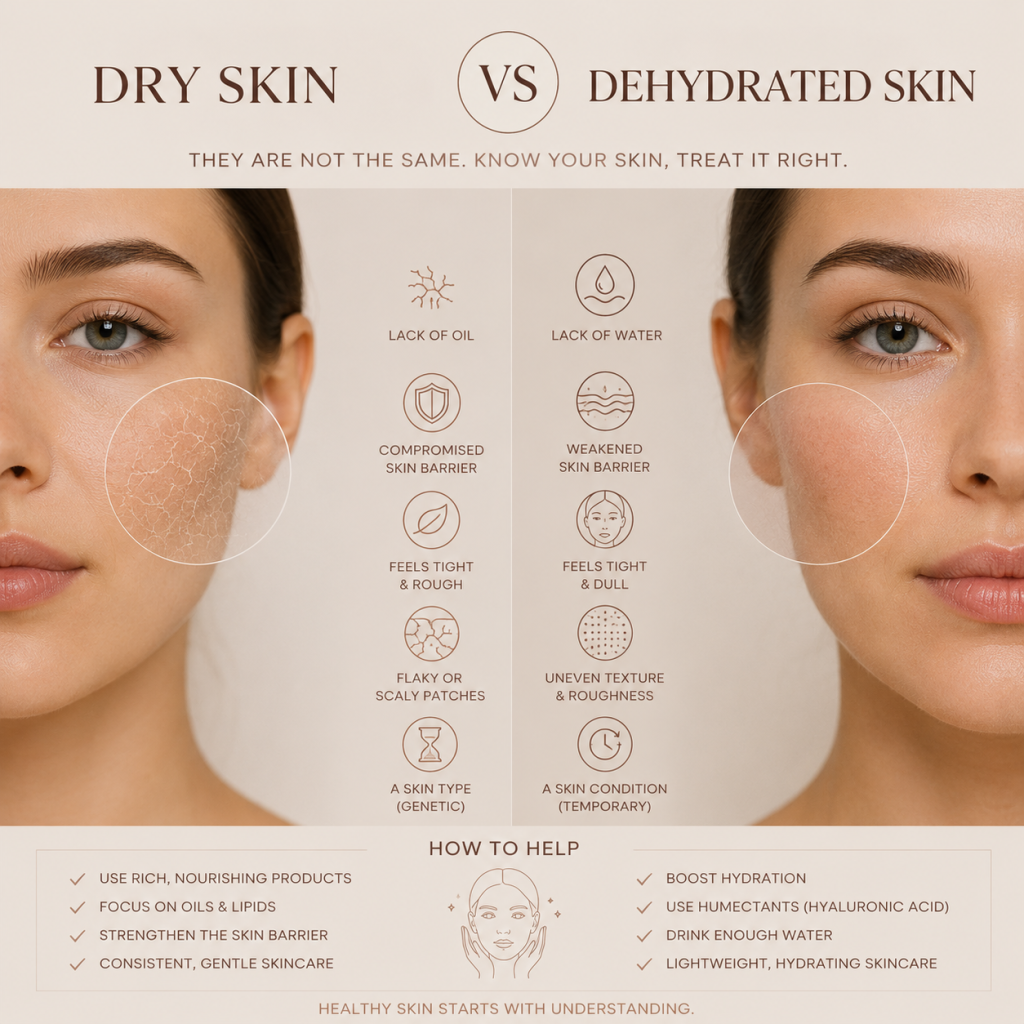
One of the most common things people say during consultations is:
“My skin is very dry.”
But in reality, many people who believe they have dry skin are actually dealing with dehydrated skin — and those are two completely different conditions.
Understanding the difference between dry skin and dehydrated skin is extremely important because they require different approaches, different skincare ingredients, and often completely different treatment plans.
Using the wrong products can sometimes worsen the problem, damage the skin barrier further, and leave the skin feeling even more uncomfortable.
In this article, we’ll explain:
Dry skin is considered a skin type.
This means the skin naturally produces less oil (sebum) than it needs to properly protect itself and maintain a healthy skin barrier.
Sebum plays an important role in keeping the skin soft, protected, and balanced. When the skin lacks natural oils, it becomes more vulnerable to irritation, water loss, and environmental damage.
Dry skin is usually genetic and often lasts long term.
People with dry skin often experience:
Dry skin often feels uncomfortable throughout the day, especially after washing the face.
Some people also notice makeup sitting unevenly on the skin because of rough or flaky areas.
Dry skin can be influenced by:
As we age, the skin naturally produces less oil, which is why dryness often becomes more noticeable over time.
Dehydrated skin is completely different.
It is not a skin type — it is a temporary skin condition caused by a lack of water in the skin.
This means:
Many people are surprised to learn that oily skin can actually suffer from dehydration quite severely.
When the skin lacks water, it often tries to compensate by producing more oil, which can create a cycle of:
Dehydrated skin often appears:
Fine dehydration lines may become more visible, especially around the eyes or forehead.
Unlike dry skin, dehydrated skin may still produce oil.
Many people notice:
This combination is a strong sign of dehydration rather than dryness.
Modern lifestyles play a huge role in dehydration.
Common causes include:
One of the biggest issues seen today is overusing active ingredients without supporting the skin barrier properly.
Many people use:
This often leaves the skin inflamed, dehydrated, and reactive.
The skin barrier is one of the most important parts of healthy skin.
Its role is to:
When the barrier becomes compromised, the skin loses water more easily and becomes vulnerable to irritation and inflammation.
Signs of a damaged skin barrier may include:
Supporting the barrier is often the first step before introducing stronger aesthetic treatments.
The easiest way to remember it is:
Dry skin needs nourishment and lipids.
Dehydrated skin needs hydration and barrier support.
Sometimes the two conditions can exist together, which is why professional skin assessment is so important.
Dry skin often benefits from:
These ingredients help rebuild and protect the lipid barrier.
Dehydrated skin usually responds well to:
Hydration-focused skincare helps attract and retain water within the skin.
Skin condition plays a major role in treatment outcomes.
Treatments performed on dehydrated or barrier-damaged skin may increase:
This is why professional consultations are so important.
Sometimes the best approach is not immediately choosing the strongest treatment, but first focusing on:
Healthy skin always responds better to advanced treatments.
Depending on your skin needs, treatments may include:
Every skin is different, and treatment plans should always be tailored individually.
Understanding your skin properly is one of the most important steps in achieving long-term healthy skin.
Many people spend years treating the wrong problem simply because dryness and dehydration can look very similar.
The truth is:
healthy skin is not only about active ingredients or aggressive treatments — it is about balance, hydration, barrier health, and consistency.
Once the skin becomes healthier internally, almost every treatment works better and results become more predictable and longer lasting.